 My Ideal World
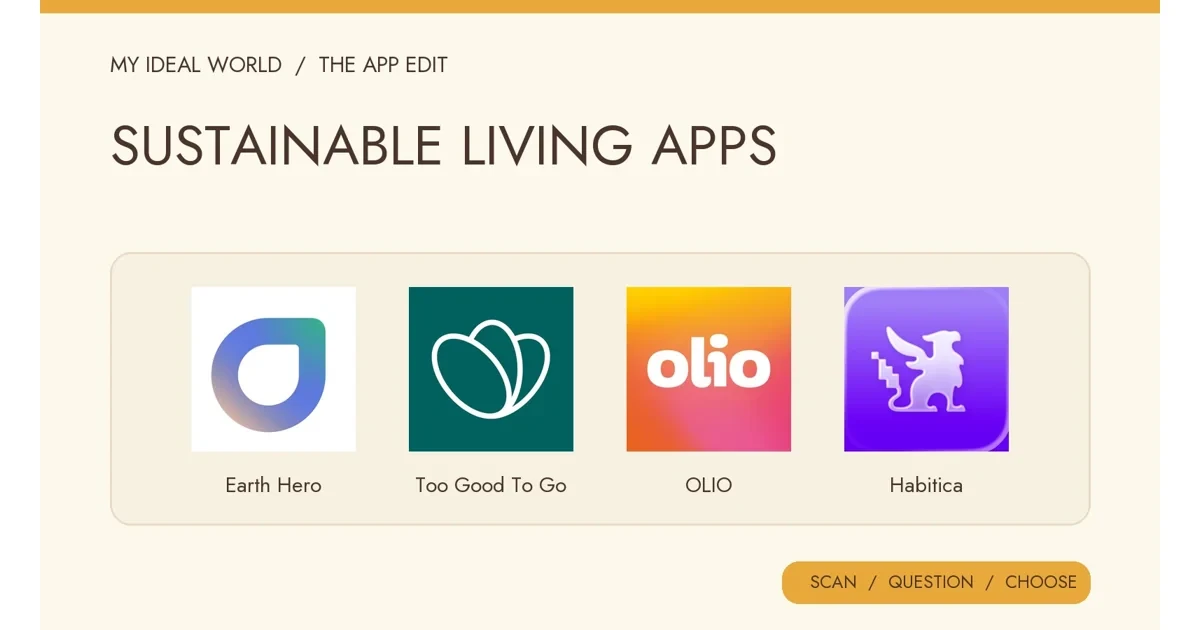
Apps for sustainable living are useful when they fit a habit you are actually trying to change. Food sharing, fabric checks and company research need different kinds of information.
Installing fifteen apps does not establish that you are wasting less or buying better. A long feature list can leave the ordinary decision just as difficult.
This guide compares the job each service supports and the evidence behind the answer. I separate planning and discovery from measured results.
Coverage, access and local services change. A tool can help you investigate an option without guaranteeing that it is available or suitable for you today.
Choose one repeated task and try the tool that supports it. Keep the result that helps you act and the source that lets you check why.
How did Too Good To Go start?
Too Good To Go started as one specific app that matched surplus food from businesses with customers who could use it, and cofounder Lucie Basch says the team focused on saving more meals each day.
Too Good To Go cofounder Lucie Basch told National Geographic that the team focused on saving more meals each day. Their original app matched surplus food from businesses with customers who could use it. It was specific and useful. It was not a complete sustainability universe.
That lesson matters to My Ideal World. We have many hubs, but the reason someone visits one should be clear. The brand information should help the ingredient conscious shopper. The farm map should help a traveller locate an actual producer. The habits should support a routine that survives ordinary life.
Olio deals with sharing. HappyCow deals with plant based food discovery. Good On You rates fashion brands. Give each service its credit. Then explain where our research, documentary reporting and category purity criteria add information those tools do not promise to supply.
Basch’s founder interview is worth reading for the origin of a useful app that didn’t begin with a hundred different features.
Does My Ideal World give these apps a purity score?
My Ideal World gives a purity score only to an identifiable product with a declared composition, so these apps get no score.
My Ideal World does not invent a numerical purity rating to fill a blank. A result needs an identifiable item, declared composition, supporting source, coverage and a versioned category rule. This comparison makes those distinctions visible.
| Subject | Throne Standard score | Why | Relevant standard |
|---|---|---|---|
| The apps Olio, Too Good To Go, HappyCow and Good On You | Not rated | These are tools for different consumer decisions, not packaged goods. No Throne Standard product purity score is assigned to an app. | Score an exact food, cosmetic or textile record only when a current category assessment exists. |
| My Ideal World | Source backed reports only | Open a specific brand or product record to see its category, method version, source date and evidence status. | Explore and sign up |
What we deliberately do not score. We do not use app downloads, community ratings or popularity as a proxy for material purity. Missing or conflicting declarations stay unresolved. To challenge a record, use the corrections process.
There is no single best app for every kind of sustainable life. Sometimes I am trying to find plant based food in a new city. Sometimes I am researching whether a material is what its packaging claims. Sometimes I want a place I can return to my notes and remember the habits I made at home. The jobs are different. The best app depends on the decision.
Which sustainable living app supports which decision?
Each sustainable living app in this table supports a different decision, and none of them settles every question.
| App | Useful for | What it does not settle |
|---|---|---|
| Olio | Sharing surplus food and goods | Full product composition |
| Too Good To Go | Rescuing surplus meals | Supply chain ethics of every item |
| Good On You | Fashion brand ratings | Lab measurements of each garment |
| HappyCow | Finding vegan friendly food while travelling | Ingredient provenance of every dish |
| My Ideal World | Keeping research, comparisons, hubs, tools and habits connected | Does not replace independent testing or unavailable evidence |
Are Android and Apple app download numbers public?
Android downloads are published by Google Play as rounded minimum thresholds; Apple does not publicly provide cumulative app downloads. The Apple figures below are marked undisclosed rather than guessed. These figures do not measure monthly active users, product scanning accuracy or retention. Checked in November 2026.
| App | Android downloads | Apple iPhone downloads | Source or next step |
|---|---|---|---|
| Too Good To Go | 50M+ | Not publicly disclosed | Google Play installation threshold |
| Olio | 5M+ | Not publicly disclosed | Google Play installation threshold |
| HappyCow | 1M+ | Not publicly disclosed | Google Play installation threshold |
| Good On You | 100K+ | Not publicly disclosed | Google Play installation threshold |
| My Ideal World (MIW) | Not publicly disclosed | Not publicly disclosed | Explore the app and sign up |
Does My Ideal World score food like a nutrition app?
No, My Ideal World does not score food the way a nutrition app scores calories, macronutrients or a general healthy eating index. We are interested in what a product is made of, the ingredients that have been identified under the relevant category rule and whether a current source backs the conclusion.
A purity preference is a stated standard, not a promise that every whole food is medically suitable for everybody.
I give Coca-Cola no number until a linked product record, ingredient breakdown, calculation date and Standard version stand behind it.
An ingredient label containing several additions is worth examining against a whole food rule, but the result must come from the rule, not the reputation of the company.
Chocolate is another useful example of why the underlying sample matters. The Auro Chocolate report distinguishes readable ingredient evidence from supply chain questions such as grower traceability, monitoring and living income.
We do not repeat an older purity score as if it were current. An ethical concern is not silently blended into the product’s ingredient number.
We do not infer food safety from the word organic, declare a processed ingredient toxic just because it has a chemical name, or downgrade a brand for an unrelated social media controversy inside its composition score. The actual product, source and dated rule must do the work.
Explore My Ideal World and sign up for the underlying research, rather than treating another app’s numerical score as our result.
Google Play figures are lower bound installation bands. Apple provides actual download statistics to each publisher through App Store Connect, not as a comparable public leaderboard. An App Store rating count is not a download count.
My Ideal World is listed last because it is our app, and no unverified install figures are claimed. Apple developer explanation of download reports.
Which is the best app for sustainable living?
The best app for sustainable living depends on the habit you are trying to change, because food waste, vegan meals, clothing brands and household ingredients are different problems.
Is the best app for habit tracking also the best sustainability app?
Not necessarily. A general habit tracker can remind you to do something. A sustainability tool should also help you decide what is worth doing and where a claim needs checking. I would rather keep one realistic food waste habit than collect a dozen badges for actions I cannot verify.
Our zero waste travel and habits guide explores that distinction. My Ideal World’s web account can connect saved discoveries, habits and points that open reports; it is not a medical fitness tracker or a substitute for specialist health records software.
Before a trip, identify where you can eat and which producers or makers you might visit. On arrival, ask the composition questions that matter. After a visit, save the useful sources and the uncertainty you still need to investigate. It is not a purity contest; it is a way to make a deliberate choice without reopening twenty tabs.
What real founders say. Olio cofounder Tessa Clarke has discussed the ordinary problem of surplus food in interviews; the point is practical waste prevention, not a promise that every rescued meal has perfect provenance. Read Olio’s own explanation and the Too Good To Go model before deciding which tool meets your needs.
The other questions deserve their own articles. If composition is the concern, start with our scanner comparison. If animal derived ingredients matter, read apps for vegans. If a stay markets itself as healthy, see the evidence behind one Saint Lucia retreat investigation.
What problem does each sustainable living app solve?
Too Good To Go recovers surplus food, Olio shares goods and food, Good On You investigates fashion companies and HappyCow finds plant based places to eat.
Some people want to reduce food waste. Others need help finding vegan meals, checking clothing brands or decoding household ingredients. Those are different problems.
Too Good To Go helps recover surplus food from participating businesses. Olio connects people who can share goods and food. Good On You investigates fashion company practices. HappyCow helps someone find plant based places to eat.
My Ideal World is designed to connect product and place research with the practical habits a person wants to keep.
A list that simply ranks those five as though they offered the same feature is not helping anyone. It should tell the reader which problem each app solves, what it does not verify and whether a separate tool is needed for the next question. A successful app can be modest about its scope and still be indispensable for the person who needs it.
What do sustainable app download numbers reveal?
Google Play displays over fifty million Android downloads for Too Good To Go and over five million for Olio. HappyCow has more than a million Android downloads, while Good On You shows more than one hundred thousand.
These figures demonstrate interest in different parts of sustainable living, but they don’t tell us how many people are active, whether the app works in a particular city or whether it changed an actual habit.
Apple does not show comparable public lifetime download totals. An iPhone’s App Store rating count is not an install count. The table above marks iOS figures undisclosed rather than inferring them from ratings.
My Ideal World belongs last in the list with a link to the sign up page and no fabricated audience number. It is a new platform and its value has to be shown in what it helps people do.
The food waste app paradox. Too Good To Go can prevent edible food from being discarded, yet a mystery bag may contain items a vegan cannot eat, a person with an allergy must avoid or a buyer would not otherwise want.
Food rescue is a legitimate goal, but it doesn’t cancel dietary needs or composition preferences. A person can value the business model and still decide that a particular offer isn’t suitable.
The same applies to Olio sharing. Finding a neighbour who can use an unwanted item is helpful, but quality, safety and the relevance of the item still matter. Community based systems depend on actual local participation.
A huge total download count won’t help if there are no useful offers near you. Reach is not the same as coverage where you live.
Why does travelling change sustainable habits?
When I move between documentary shoots, I can lose the routines that work at home. The nearest vegan restaurant changes; drinking water arrangements change; a product I recognise disappears from shops; a farm I wanted to visit may be closed for the season.
A useful app helps me answer the immediate question and preserve what I’ve learned for the next place.
That is the role I want from My Ideal World. It should connect the product record, grower interview, local food guide, eco stay investigation and practical habit without requiring me to start from zero. It should also admit when a source is outdated or the app doesn’t have a verified answer. Reliability is the feature worth protecting.
What does a practical sustainable week look like?
Choose one food waste habit, one local producer, one ingredient or material question and one repair or reuse action. Record what you actually did and which tool helped. If the recycling service was unavailable or drinking water was uncertain, don’t pretend a habit streak solved those problems. Make the routine fit real conditions.
A product database can contain millions of records and still fail to change a single decision. A tiny habit that is repeated consistently may matter more to the individual user. That’s why an app guide should be measured not only by website visits or install clicks, but by whether the reader knows what to do next and wants to return.
How should a sustainable app earn your sign up?
A sustainable app earns the sign up by giving a useful answer first, including cases where another service is clearly better suited to the job. It should show the comparison criteria, a relevant example and the limits of the data, and only then invite you to explore the part of My Ideal World that solves the next step.
I don’t want every article to be a brochure listing all app features. A food waste piece can mention food habits and local sourcing. A fashion article can mention materials and supplier research. A wellness stay story can link to water and food questions. Their connections make the broader app coherent without repeating the same sales pitch in every post.
Which sustainable app feature would you really use again tomorrow?
For some people, a local food app is genuinely useful every week. Others need a habit tracker or a way to scrutinise a brand’s green claims before making a purchase.
Instead of searching for one perfect eco friendly app, I would visit the My Ideal World tool directory and choose a single decision to improve, such as clothing materials or a shopping list. The value is in using the evidence, not adding another icon to your phone.
Where should you start with sustainable living apps?
Start with the decision in front of you, then use Start Here in the My Ideal World tools to find the tool that fits it.
A broad change becomes easier to act on when you name the decision in front of you. Start Here provides an entry point into the tools. Choose the question that fits what you need to buy, keep or investigate, and save the evidence you will want when the same decision comes round again.
Where does the information in this comparison come from?
The information in this comparison comes from the published sources listed below.
Keep the evidence close. Explore the related research and create your My Ideal World account. Check the app page for current web and mobile availability.