 My Ideal World
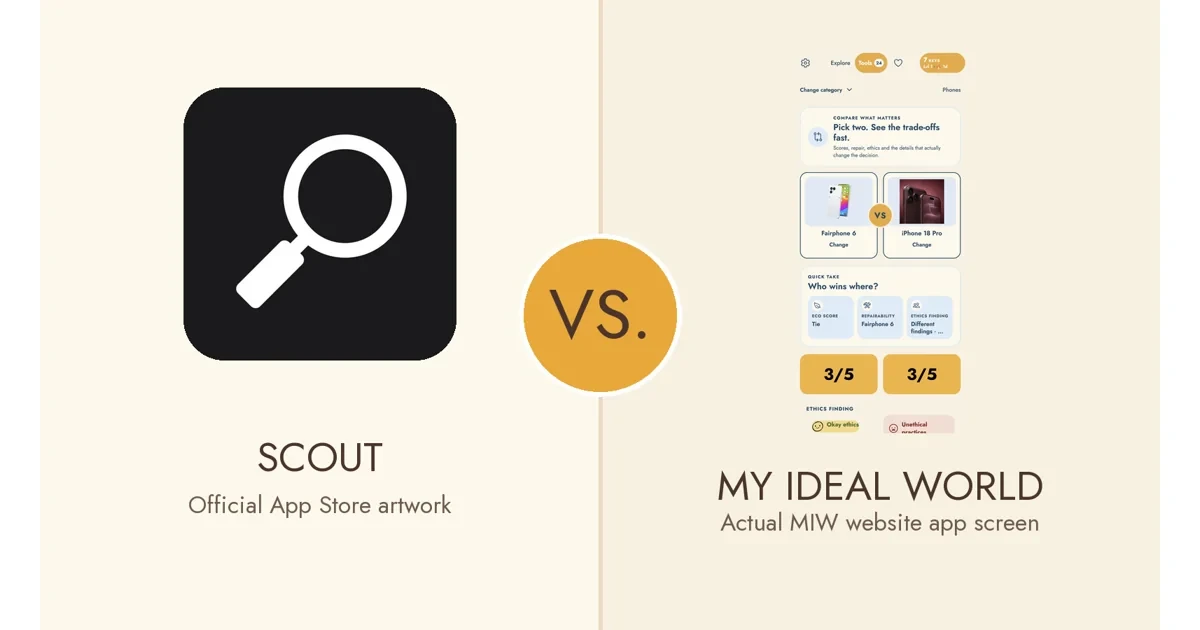
Scout vs My Ideal World is a comparison of what sits behind a product result. A score is useful only when I can see what it measures.
Paying for an app does not establish that its answer is better. A competitor criticising that subscription does not establish the opposite either.
Scout publishes its methodology, while Tallow has published its own criticism of Scout. I separate those companies’ statements from the underlying evidence in this comparison.
A label, a laboratory result and a judgement about an ingredient are different records. One cannot silently stand in for another, and a missing source remains a gap.
I want to know whether another reader can follow the same product, units, method and date. That is the standard I would apply to Scout and to our own work.
How does Scout explain its pricing?
Scout uses a direct line in its official store description to explain its pricing approach.
“No fake ‘free’ features.”
I value that clarity more than an apparently free button that reveals a price after fifteen screens.
But Tallow founder Maddox Schmidlkofer argues that a shopper should be able to examine common product ingredients before entering a payment. His article about Scout is a competing company’s sales argument, written to lead readers towards Tallow. That doesn’t mean every observation is wrong. It means each one needs a screenshot and a date.
There is an awkward detail in the hummus example. Tallow acknowledges that Scout had a laboratory attachment it did not. That is precisely the kind of admission I want in a real comparison. If the other service has better evidence on one product, say so. Then ask whether the lab report changed the score or only appeared beside it.
Two barcodes, two versions, two scores. This is where I would start an actual test. Not with which founder has the bigger audience. The package, the data source, the criterion and the correction are what matter.
Read Maddox’s critique beside Scout’s methodology and the official store description.
Are an ingredient alarm, a lab result and a score the same record?
No, an ingredient alarm, a laboratory result and a score are three separate records, and a measurement only matters to the score if a version of the rule uses it.
Scout’s published methodology describes a category relative score. It also discusses packaging, processing and ethical adjustments.
Some product pages display independent laboratory data alongside the main number. The important question is whether a measurement changes the score, and if so exactly which version of the rule uses it.
If the laboratory report states a quantity per kilogram and a product contains only a few grams per serving, the public number needs the correct conversion before anybody compares it to a daily exposure reference. The lesson from the LMNT case is not that testing is unhelpful.
It’s that even a correct laboratory measurement can become a false consumer warning when translated carelessly.
One batch isn’t every batch. A drink tested in one month does not establish that every bottle manufactured in another facility has the same concentration.
Nor does the absence of a linked lab report mean the product is contaminated. A well built record would tell us sample identity, analyte, date, unit and uncertainty instead of allowing the score to imply a degree of proof it cannot support.
I also want the source visible when a company changes how it penalises an ingredient. If a rule changes on Tuesday and the product drops twenty points, that is a policy revision.
The food did not spontaneously acquire a new compound. Those histories belong next to the score.
Is Tallow’s criticism of Scout impartial?
Tallow is a competitor, so its criticism of Scout’s pricing and duplicate records is not impartial, though it can still expose a weakness.
Tallow’s founder has criticised Scout’s pricing and duplicate records. He has also acknowledged occasions where Scout displayed a laboratory source his own service did not have.
That concession matters because it gives the reader something concrete to test. A criticism is stronger when the writer is willing to show where the rival wins.
Scout’s published pricing and app store offers need to be checked in the reader’s country and on the day they subscribe. A free web result can coexist with a paid scanner; the existence of one doesn’t prove the other is misleading.
I want readers to see the exact paywall, not a stale figure pulled from somebody else’s grievance.
Neither founder’s confidence is evidence about a particular food. If they disagree over a product, show both versions and the product label.
If the disagreement concerns a laboratory reading, show the actual report. If the dispute is about a subscription, open the checkout.
There is no reason to blend all three into a dramatic allegation about accuracy.
MIW should be subjected to the same questions. Version 3.0 and a larger dataset are not evidence that every record is correct.
I can explain why composition purity matters to me and still admit that source matching, unverified ingredients and category rules require ongoing correction.
What should an online product comparison tool show?
When two scanners disagree, I want the exact barcode, formulation, date and source evidence shown together. Without those details, a dramatic comparison may simply be comparing different records. The strongest product comparison tool online lets us question its result.
Explore the Product Comparison tool for saved catalogue records and the Yuka comparison for how two scoring philosophies can produce different answers without changing the food.
Months spent preparing My Ideal World’s product records have made me suspicious of certainty without a source. Data can be collected through scripts, checked with AI and checked again by a person. It can still be matched to the wrong product. That is why I want the formula, country, date and report status visible.
If Scout and MIW disagree on an ingredient, I would open both methods before assuming a scandal. The important distinction is whether the app observed the product, read its label or inferred a risk from a general rule. Our investigation into the LMNT dispute explains why the unit attached to a laboratory number can change the story.
Use My Ideal World’s sign up when you want to keep researching the brand after the barcode. A disagreement deserves documents, not louder marketing.
What does the Throne Standard score check?
The Throne Standard’s Food pack (version 1.0.0 under Standard 2.2) checks a complete, attributable ingredient declaration against explicitly named processing marker preference rules. A missing, partial or unmatched declaration remains unresolved. This is a composition preference assessment, not a laboratory health and safety finding.
What we will not score as if it were composition. We do not turn processing markers into claims of poisoning, prove the presence of contaminants from a label, or grade an entire multinational’s labour conduct from one soft drink. Natural flavourings are not proof of purity or danger. We do not score an incomplete ingredient list as zero.
Read the standard version named in the individual report, together with its metric, evidence dates, eligible products and coverage. Category specific methods can answer different questions, and the live report may use a later version than an older explanatory page.
A missing or conflicting declaration is unresolved, not proof of a bad composition. You can challenge an incorrect record.
What does this comparison show?
This comparison shows the first tool or document to use for each question, and the limit of each one. These are different kinds of evidence. Before choosing an app, distinguish a label derived ingredient, a scoring rule, a measured quantity and a brand policy. The table names the limits rather than declaring an unsupported winner.
| Question | First tool or evidence | Important limit |
|---|---|---|
| Scale | Scout 1 to 100, relative to category | Compare exact MIW score range and version |
| Ingredients | Scout reads ingredient lists | Check MIW identity, data source and amounts |
| Lab results | Scout says lab results are disclosed alongside the score | Check which product records show actual assays |
| Ethical events | Scout documents an ethics related overlay | Check whether MIW uses separate, attributable evidence |
| Corrections | Scout documents versioning and review dates | Check the MIW equivalent |
How would My Ideal World score the brands?
The My Ideal World score is a test against the Throne Standard, not a prize for whichever app has the most downloads. The relevant published standard is versioned, and category results must keep their own meaning.
An ingredient preference, laboratory result, animal welfare policy and nutritional profile are not interchangeable evidence.
The live reports checked on 17 November 2026 show Picture at 1/5 and Gray Label at 3/5 under the report’s Throne Standard 3.0.0 composition assessment. Picture has 37.18% verified plant evidence across 971 complete declarations from 1,116 eligible products, with 39 missing declarations and 106 technical gaps.
Gray Label has 85.67% verified plant evidence across 305 complete declarations from 394 eligible products, with no missing declarations and 89 technical gaps. Coverage is 87.01% for Picture and 77.41% for Gray Label. Both reports describe these as provisional results with incomplete coverage, rather than final whole brand assessments.
These numbers demonstrate our composition method; they are not a head to head benchmark against Scout, Oasis, Tallow or Yuka.
| Brand | Current score | Why | Report |
|---|---|---|---|
| Picture, clothing | 1/5 | 37.18% verified plant evidence; 971 of 1,116 eligible declarations complete. Provisional result with 87.01% coverage. Checked 17 November 2026. | Picture report |
| Gray Label, clothing | 3/5 | 85.67% verified plant evidence; 305 of 394 eligible declarations complete. Provisional result with 77.41% coverage. Checked 17 November 2026. | Gray Label report |
| Coca-Cola | Not scored | The ingredient declaration can be checked, but a declaration alone is not a current Throne Standard product score. | No report linked |
I give Coca-Cola no score. Its ingredient declaration can support a description of the formula, but a declaration alone is not a current Throne Standard product result.
We do not award or deduct purity points for downloads, App Store reviews, subscriptions, celebrity endorsements or online arguments. Nor is a composition score a calorie score, a personal medical risk score, a laboratory contaminant test or an automatic judgement on labour conditions.
The current Throne Standard makes different categories and assessment limits explicit. Where no current assessment exists, we say so rather than borrowing another scanner’s score.
Explore My Ideal World and sign up for the underlying research, rather than treating another app’s numerical score as our result.
Are Android and Apple app download numbers public?
Android downloads are published by Google Play as rounded minimum thresholds; Apple does not publicly provide cumulative app downloads. The Apple figures below are marked undisclosed rather than guessed. These figures do not measure monthly active users, product scanning accuracy or retention. Checked in November 2026.
| App | Android downloads | Apple iPhone downloads | Source or next step |
|---|---|---|---|
| Scout | 10K+ | Not publicly disclosed | Google Play installation threshold |
| My Ideal World (MIW) | Not publicly disclosed | Not publicly disclosed | Explore the app and sign up |
Google Play figures are lower bound installation bands. Apple provides actual download statistics to each publisher through App Store Connect, not as a comparable public leaderboard. An App Store rating count is not a download count.
My Ideal World is listed last because it is our app, and no unverified install figures are claimed. Apple developer explanation of download reports.
How many people use Scout?
Scout’s Google Play developer, Wise Concepts LLC, had about 30,000 tracked Android installs according to a third party tracker in November 2026. That count covers Android and is neither an Apple total nor monthly active usage.
The app also had around 4,000 US App Store ratings in a contemporaneous competitor review, but a rating is not a download. Where MIW has no public verified install total, the honest comparison has a blank space rather than an invented figure.
How does Scout score products?
Scout rates products within categories from 1 to 100, examining ingredients, processing and packaging, and it also describes ethical event adjustments. Its method says laboratory results can be displayed separately from the core calculation.
Some product pages have used language suggesting lab findings affect scores, creating a question readers deserve answered. Exactly which fields count in which version of the score? That is a request for clarification, not proof of fraud.
What is the Scout and Tallow argument about?
On 15 November 2026 Tallow founder Maddox Schmidlkofer criticised Scout’s paywall and product duplicates. He also acknowledged Scout had a lab result attached to Sabra hummus that Tallow did not.
That concession is important. A competitor can be ahead on one field and behind on another. The criticism came from someone selling a competing scanner, so it needs to be labelled as such and independently checked.
Should a laboratory result change a Scout score?
A laboratory result should change a Scout score only where the published version of the method says so, and readers should be told whether the number includes it.
Scout’s methodology has described lab results as disclosures that can sit alongside the core score. Readers should know whether the displayed number includes those measurements, or whether the laboratory finding is a separate panel.
The answer may depend on the methodology version. The site should publish what changed, when and why; it should not rely on a product description that could be interpreted differently from the formal scoring document.
If a test concerns lead, glyphosate, PFAS or another analyte, the result also needs a sample identity, unit, method, laboratory and comparison threshold. A contaminant concentration is not a lifetime personal exposure estimate.
The Oasis and LMNT litigation makes that distinction particularly important. A competitor’s claim about a rival is not a substitute for the underlying lab PDF and a properly checked calculation.
Why does Scout’s 1 to 100 scale look simple?
Scout’s scoring scale looks simple because the complicated work is hidden behind it
A one to one hundred score is comforting because it appears to put very different products on a common scale. Scout’s method is category relative, which means the number must be read in the context of what is being compared.
A bottled water and a protein powder have different purposes. So do a surface cleaner and a face cream. Anyone comparing their numerical ratings as if they measured one universal quantity is misreading the score.
A sound comparison must first ask what the score is intended to optimise. Are we penalising processing, ingredients of concern, packaging, or brand controversies? Each dimension needs evidence. The final weighting is an editorial decision as much as a technical calculation.
Can an ethics overlay be treated like an ingredient?
No, an ethics overlay records a dispute about an organisation at a point in time, not part of the material composition of a product.
A documented environmental or labour dispute concerns an organisation, event and time period. It is not literally part of the material composition of a product.
If a brand score incorporates an ethical event adjustment, readers should be able to see which incident, what evidence supports it, the date and whether the situation has since changed.
I take brand conduct seriously. But an accusation against a corporation’s subsidiary should not be mechanically transplanted onto every item without clear rules. Nor should a sponsored relationship affect the rating. The distinction matters to consumers and to the people whose work is being evaluated.
What should you do about a duplicate scanner score?
Before calling a duplicate score a bug, compare the barcodes, product sizes, ingredient panels and dates of the two records.
A database can contain the same branded food under more than one identifier, or record two genuinely different package versions under a similar name. Before calling the inconsistency a bug, compare the barcodes, product sizes, ingredient panels and dates.
If those match, conflicting scores deserve correction. If they don’t, the app needs to explain why the records remain separate.
Tallow’s founder has publicly raised Scout duplicate record concerns. He is also a direct competitor. His screenshots may identify a useful test case, but his conclusion should not be treated as a neutral audit without independent replication. This is exactly the kind of dispute that an open correction history can settle.
Is the Scout and Tallow dispute commercial or technical?
The Scout and Tallow founder dispute is commercial as well as technical, because scanner businesses compete for subscribers, search traffic and brand trust.
Scanner businesses compete for subscriber attention, search traffic and brand trust. One company’s comparison of another can be genuinely informative and still strategically written to convert readers.
Scout has published comparison pages; Tallow has answered with its own review. Both have an incentive to emphasise the dimensions on which their product performs well.
What matters to me is whether the comparison provides enough detail for a reader to reach a different conclusion. Screenshots, product identifiers, date stamped prices and links to the methods make the claim testable. Insults about ownership or the motives of a founder are not a substitute for independent evidence.
Why can a frightening scanner rating mislead?
A dramatic red number can get attention and encourage people to share a screenshot before checking the evidence. That is an interface problem as much as a data problem. Does the app lead with the raw source and explain the confidence level, or does it make the most alarming conclusion easiest to pass around?
A strict standard can be honest and still be harsh. I know that because MIW’s composition rules sometimes give low scores to businesses owned by people I know. That is uncomfortable. The way to respect both sides is not to secretly lift a friend’s rating, but to explain the category rule, show the underlying information and invite a documented correction.
What three questions does a protein powder raise?
A protein powder raises three separate questions, about its ingredient list, any laboratory assay for a contaminant and how its packaging was produced.
A product may have a long ingredient list, a laboratory assay for a particular contaminant and claims about how its packaging was produced. Those are separate datasets.
A reader could care most about the ingredient mix, the measured contaminant or the environmental cost. A single number cannot express all three without a transparent decision model.
Suppose two brands have very similar formulas but only one has published testing. It would be wrong to assume the untested product is contaminant free. It could also be unfair to punish the tested brand simply because it disclosed a low level finding. An absence of data must not automatically become a positive result.
Is a brand name the same as a product identity?
No, a brand name found by text search can point to an earlier flavour, a larger package or a regional formulation.
A product found by text search can be an earlier flavour, a larger package or a regional formulation. If the app attaches an ingredient or laboratory finding to the wrong variation, the error is not in arithmetic alone.
It begins with entity matching. A careful audit asks whether the global trade item number, package size, ingredients and market all match.
This becomes particularly important when the result is circulated as a social post. The screenshot may lose the barcode, version and source, leaving a company with an allegation that readers cannot independently check. A correction system needs a stable link to the exact record, not just the brand’s homepage.
Is a low scoring food unsafe?
No, a low scoring food is not automatically unsafe, because food scoring models penalise processing or chosen ingredients while food safety turns on contaminants, microbiology, allergens and storage.
Food scoring models often penalise processing or chosen ingredients. Those are classification decisions within the model.
Food safety is a different question governed by contaminants, microbiology, allergens, storage and other factors. A product can fail a purist composition rule while remaining lawfully marketed and suitable for some consumers.
Conversely, a natural ingredient product can contain a contaminant, be mishandled or have an allergen. A clean score and a safety certification should never be presented as interchangeable. A database that conflates them risks giving users false reassurance.
Why does one seed oil rule create scanner disagreement?
One seed oil rule applied to all foods creates disagreement because it reflects a founder’s nutritional philosophy, which can differ from conventional nutrition scores.
Tallow has been explicit about its preference based treatment of refined seed oils, and its 2026 comparison includes products whose scores diverge substantially from Yuka’s. Such a model can be consistent with a founder’s nutritional philosophy while disagreeing with conventional nutrition score approaches.
The better reporting question is whether a website identifies its philosophy, evidentiary support and the exact rule triggering the penalty. Calling a product score inaccurate simply because the algorithm dislikes a particular ingredient confuses methodological disagreement with an incorrect source field.
What does a category relative score mean?
A high rating relative to other products in a category may not mean a product meets a strict universal purity threshold. If an entire category is highly processed, the best item within it could still contain ingredients I personally avoid. That isn’t necessarily a calculation mistake. It reflects the scoring question.
Readers should be able to ask whether the system compares a cereal with all foods, with cereals, or with an even narrower group. The size and definition of the reference category can change the interpretation. A well documented app explains this before a shopper assumes 90/100 means the same thing everywhere.
What should a scanner’s laboratory report show?
A scanner’s laboratory report should identify the laboratory, commissioning party, tested product, batch, test date, units and quantitation limit where relevant.
A scanner may link an assay for lead, cadmium, pesticides or another analyte. The raw record should identify the laboratory, commissioning party, tested product, batch, test date, units and quantitation limit where relevant. Those fields help users decide whether the result is applicable to what they have bought.
A test on one bottle is not a guarantee about every future bottle. A test on a powdered supplement cannot be compared with a per serving threshold until the concentration and serving mass are correctly connected. The Oasis/LMNT dispute makes that distinction concrete.
How much does a free scanner experience give you?
A free scanner experience may give only part of what you expect, because a business can define just some of its scans, reasons, history and alternatives as free.
A consumer who hears that an app is free may expect barcode scans, detailed reasons, history and alternatives without payment. A business may define only part of that as free. Both positions can be described accurately if the reviewer records the actual screens, country, operating system and subscription prompt.
A free public webpage may have different features from the app. A promotional price may be limited to a trial or one account. Screenshots of old checkout offers do not show what today’s subscription costs.
Can a friend’s brand get a low My Ideal World score?
A brand owned by a friend can receive a low score under the same published rule as anyone else. That may be painful, particularly where the friend has worked hard or operates responsibly in other ways. The result must still be accurate. The product cannot be misidentified, and a composition mark should not be portrayed as proof of dishonesty.
Likewise, I should be willing to correct a low score if the friend supplies verified new material information. An independence standard doesn’t mean refusing to listen; it means applying the same corrections criteria to everybody without commercial or personal favour.
What is the difference between an evidence correction and a method change?
An evidence correction fixes a wrong fact in a record, while a method change alters how the rule scores the same facts.
Suppose a packaging label was incorrectly recorded as plastic when it was actually glass. Correcting that is a factual repair and should update the record. Suppose a publisher subsequently decides to penalise glass more strongly because of transport impacts.
That is a methodology change. The app should distinguish the two, version its rules and allow the earlier score to be reconstructed.
A shopper who saw 85 yesterday and 62 today deserves a reason. A brand should not have to guess whether its product changed or the algorithm did. This is especially important when a number has spread through social media.
Should a scanner audit include products the app cannot identify?
Yes, a transparent scanner audit should include products the app cannot identify, because a service can look highly accurate when only recognised items are tested.
A service can appear highly accurate if a reviewer measures only items it already recognises. But someone shopping internationally may encounter unknown store brands, imported goods, old packaging and products from small farms.
Coverage failures are part of whether the tool is useful in the real world.
A fair benchmark must include attempted scans that return nothing, manually entered products and duplicate matches. Count them separately from incorrect data. This avoids rewarding an app for choosing an easy test sample or punishing it for honestly saying that it lacks evidence.
Is a scanner’s confidence percentage trustworthy?
An app could add a confidence percentage next to a score, but that number needs a method too. Confidence in the barcode match, ingredient transcription and scientific risk model are distinct uncertainties.
Combining them into a single 95 per cent confidence figure without validation could create another misleading impression of precision.
Sometimes plain language is better. ‘Manufacturer label checked in August; no laboratory results found’ tells me exactly what I can use. It is more helpful than a mysterious green shield that gives the impression every part of the result has been verified.
What would a serious answer to the Tallow criticism include?
A serious answer to the Tallow criticism would name the product records at issue, the differences between them and any corrections made.
Tallow’s founder questioned aspects of Scout’s database and commercial disclosures. A solid response would specify the product records at issue, the differences between them and any corrections made.
It would also clarify the access model and relevant ownership disclosures without requiring readers to infer wrongdoing from vague insinuations.
Such a reply would be useful even if neither founder changed their opinion. It would move the debate from personality and positioning towards facts shoppers can check. My Ideal World should hold itself to the same standard if a competing app challenges our data.
Can someone with a food allergy rely on a scanner score?
A person with a confirmed allergy should not interpret a composition score as a certified absence of an allergen or cross contact. The current physical label and appropriate advice take priority.
Scanner data can assist with research, but recipe changes and manufacturing practices require specific evidence.
That is not a weakness unique to Scout. It is a limit of consumer barcode databases generally. An app that says so plainly is behaving responsibly, even if the disclaimer is less clickable than a confident promise.
Which Scout alternative should you choose?
The right Scout alternative depends on the problem you had with Scout, whether that was cost, missing barcodes, a disputed result, ingredients or a company’s ethics.
When a shopper tells me they want an alternative to Scout, I would first ask what problem they experienced. Was it cost, missing barcodes, a disputed result, distrust of ingredients or simply a desire to know a company’s ethics? Those needs lead to different recommendations.
A comparison that begins with the user’s real reason for changing apps will convert more honestly than one that declares a winner from a proprietary number. MIW is relevant when the answer requires composition, research and continuity across categories, but it should never pretend to substitute for specialist dietary safety.
Plan your next step
Follow a product’s ingredients into the brand level evidence, keeping the source and gaps visible. Take the evidence you can see, note the gap you cannot, and continue through the relevant brand or product research. Explore My Ideal World and create an account.
Continue the investigation. best brand scanner apps · how to spot greenwashing
Where does the information in this comparison come from?
The information in this comparison comes from the published sources listed below.