 My Ideal World
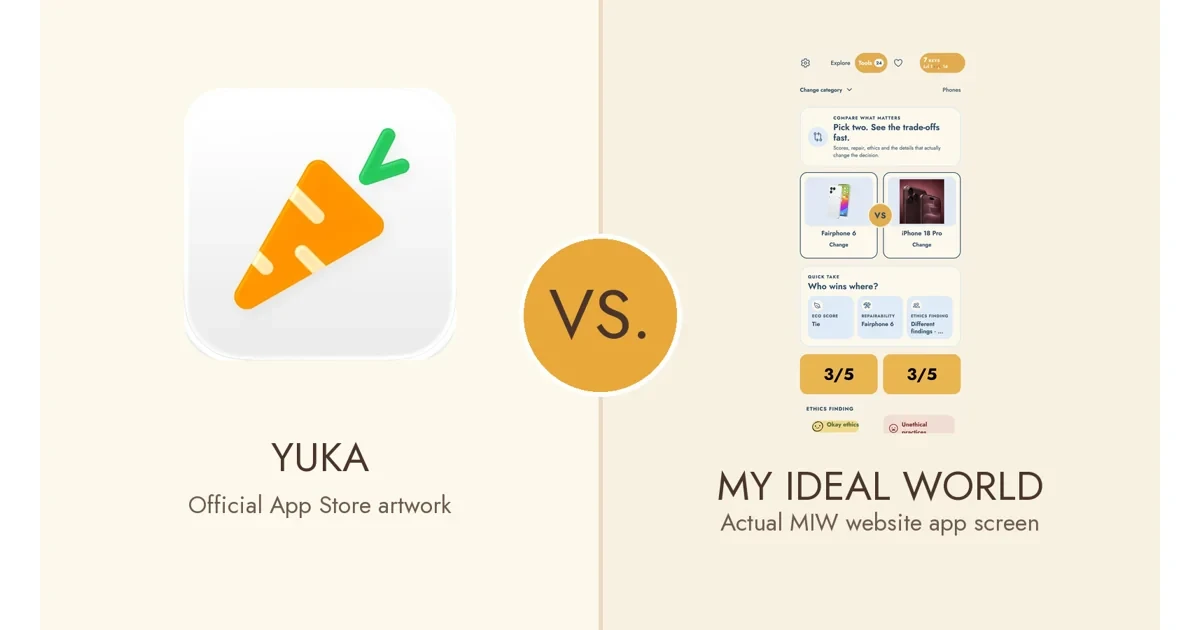
Yuka vs My Ideal World starts with what each app is trying to tell you. A food score and a record of product evidence can lead to different shopping decisions.
A reassuring colour does not explain every ingredient, supplier or condition of use. I want the method behind the answer before I let it choose what goes in my basket.
Yuka’s published food method assigns 60% to nutritional quality, 30% to additives and 10% to organic status, with an additional cap for additives it considers high risk. Those are declared scoring choices that a reader can examine.
My Ideal World’s composition preferences and category reports ask different questions. Their coverage and evidence gaps still need to be visible, and neither approach is a personal medical assessment.
The test is whether you can identify the exact product, follow the source and see why the result was reached. That is the comparison I make here.
How did Yuka start?
A cereal label helped inspire Yuka, after cofounder Julie Chapon found that one quarter of a cereal she had eaten for ten years was made with sugar.
Yuka cofounder Julie Chapon told The Washington Post she had eaten Nestlé Fitness cereal for ten years.
“When I checked the label, one quarter of this product was made with sugar.”
The revelation helped inspire the app. A cereal that looked sensible from the front had a very different story in its composition.
This is exactly the part of Yuka I value. It encourages people to turn the packaging around. But Yuka’s published food score weights nutrition, additives and organic status. Those weights are choices. My Ideal World puts purity of composition at the centre, and we need to say so without pretending the two formulas measure the same thing.
The interesting question is what happens after you discover a number you dislike. Did the manufacturer change the recipe? Was the product matched to the wrong barcode? Is the score using yesterday’s rules on today’s packaging? A reader deserves the ingredient declaration, the scoring version and the date.
Julie has also described Yuka users contacting manufacturers about additives. Collective pressure can make a company change its formula. Good. But pressure based on a mistaken product record can have consequences too. The scanner must earn the certainty it displays.
Read the interview with Julie Chapon and the later conversation about industry pressure. Then ask what your own priorities are, not what colour somebody has chosen for you.
Explore My Ideal World and its published composition standard. The score and its supporting evidence should always be readable together.
Can a food product change while its barcode stays the same?
Yes, producers reformulate and ingredients change by country, so a familiar barcode can lead a scanner to the explanation for a different recipe.
A barcode database lives in a different world from the thing on the shelf. Producers reformulate.
Ingredients change by country. Retailers sell older and newer packaging side by side.
Somebody scans the right brand but the wrong variant, and the app confidently serves an explanation for a different recipe.
That is a data matching failure, not a scientific disagreement. It deserves a visible correction with the original record retained, the replacement formula sourced and a revision date.
A manufacturer should be able to challenge a factual mismatch without having to persuade the editor to approve of the ingredient itself.
When I compare Yuka with My Ideal World I want the exact product, ingredients, country and version. Then the two methods can be placed beside each other.
If our Throne Standard gives less credit because a food is not made of whole, pure ingredients, I will say exactly that. I will not pretend Yuka secretly agrees with us or that its different weightings mean its database must be wrong.
A shopper who wants to avoid a substance for personal reasons has every right to do so. Someone with a medically significant allergy needs more than our composition preference.
Those users may stand in the same aisle, but they are asking different questions. An app earns trust by recognising the distinction.
What can a food ingredient decoder tell you that a score cannot?
A food ingredient decoder app should explain what a declared ingredient does, not pretend it has independently tested the finished product. A laboratory contaminant measurement and an additive listed on a packet are different kinds of evidence.
Try the Ingredient Decoder and Banned Additives Checker, then compare the original evidence and method behind any rating. An ingredient name is a starting point for research, not a diagnosis.
I built My Ideal World because I wanted something useful while travelling and filming, not just another coloured score in the supermarket. When I don’t recognise a product, I want its exact formulation, the maker and the source behind the claim. A green number can be a useful first glance. It cannot be the end of the investigation.
Try it with the same cereal that made you question Yuka. Compare the ingredient panel with the actual product record, then look at the maker’s evidence separately. The Scout, Oasis and Tallow investigation shows why errors in data identification and laboratory interpretation are different problems. I want that distinction visible whenever somebody trusts our own score.
To follow the research rather than another quick score, create a My Ideal World account. The point is to revisit the evidence as a formula or scoring rule changes.
What does the Throne Standard score check?
The Throne Standard’s Food pack (version 1.0.0 under Standard 2.2) checks a complete, attributable ingredient declaration against explicitly named processing marker preference rules. A missing, partial or unmatched declaration remains unresolved. This is a composition preference assessment, not a laboratory health and safety finding.
What we will not score as if it were composition. We do not turn processing markers into claims of poisoning, prove the presence of contaminants from a label, or grade an entire multinational’s labour conduct from one soft drink. Natural flavourings are not proof of purity or danger. We do not score an incomplete ingredient list as zero.
Read the standard version named in the individual report, together with its metric, evidence dates, eligible products and coverage. Category specific methods can answer different questions, and the live report may use a later version than an older explanatory page.
A missing or conflicting declaration is unresolved, not proof of a bad composition. You can challenge an incorrect record.
What does this comparison show?
This comparison shows the first tool or document to use for each question, and the limit of each one. These are different kinds of evidence. Before choosing an app, distinguish a label derived ingredient, a scoring rule, a measured quantity and a brand policy. The table names the limits rather than declaring an unsupported winner.
| Question | First tool or evidence | Important limit |
|---|---|---|
| Food rating | Yuka publishes a nutrition/additives/organic weighting | Check MIW’s documented formula and source trace |
| Cosmetics | Yuka evaluates ingredients under its own hazard method | Composition, concentration and exposure need separate treatment |
| Brand transparency | A product score is not a company audit | Look for evidence on ownership, suppliers and labour |
| Corrections | Check how changed formulations are processed | Look for a review date and correction history |
How would My Ideal World score the brands?
The My Ideal World score is a test against the Throne Standard, not a prize for whichever app has the most downloads. The relevant published standard is versioned, and category results must keep their own meaning.
An ingredient preference, laboratory result, animal welfare policy and nutritional profile are not interchangeable evidence.
The live reports checked on 17 November 2026 show Picture at 1/5 and Gray Label at 3/5 under the report’s Throne Standard 3.0.0 composition assessment. Picture has 37.18% verified plant evidence across 971 complete declarations from 1,116 eligible products, with 39 missing declarations and 106 technical gaps.
Gray Label has 85.67% verified plant evidence across 305 complete declarations from 394 eligible products, with no missing declarations and 89 technical gaps. Coverage is 87.01% for Picture and 77.41% for Gray Label. Both reports describe these as provisional results with incomplete coverage, rather than final whole brand assessments.
These numbers demonstrate our composition method; they are not a head to head benchmark against Scout, Oasis, Tallow or Yuka.
| Brand | Current score | Why | Report |
|---|---|---|---|
| Picture, clothing | 1/5 | 37.18% verified plant evidence; 971 of 1,116 eligible declarations complete. Provisional result with 87.01% coverage. Checked 17 November 2026. | Picture report |
| Gray Label, clothing | 3/5 | 85.67% verified plant evidence; 305 of 394 eligible declarations complete. Provisional result with 77.41% coverage. Checked 17 November 2026. | Gray Label report |
| Coca-Cola | Not scored | The ingredient declaration can be checked, but a declaration alone is not a current Throne Standard product score. | No report linked |
I give Coca-Cola no score. Its ingredient declaration can support a description of the formula, but a declaration alone is not a current Throne Standard product result.
We do not award or deduct purity points for downloads, App Store reviews, subscriptions, celebrity endorsements or online arguments. Nor is a composition score a calorie score, a personal medical risk score, a laboratory contaminant test or an automatic judgement on labour conditions.
The current Throne Standard makes different categories and assessment limits explicit. Where no current assessment exists, we say so rather than borrowing another scanner’s score.
Explore My Ideal World and sign up for the underlying research, rather than treating another app’s numerical score as our result.
Are Android and Apple app download numbers public?
Android downloads are published by Google Play as rounded minimum thresholds; Apple does not publicly provide cumulative app downloads. The Apple figures below are marked undisclosed rather than guessed. These figures do not measure monthly active users, product scanning accuracy or retention. Checked in November 2026.
| App | Android downloads | Apple iPhone downloads | Source or next step |
|---|---|---|---|
| Yuka | 10M+ | Not publicly disclosed | Google Play installation threshold |
| My Ideal World (MIW) | Not publicly disclosed | Not publicly disclosed | Explore the app and sign up |
Google Play figures are lower bound installation bands. Apple provides actual download statistics to each publisher through App Store Connect, not as a comparable public leaderboard. An App Store rating count is not a download count.
My Ideal World is listed last because it is our app, and no unverified install figures are claimed. Apple developer explanation of download reports.
Why does Yuka have a lead in public adoption?
Yuka’s own press kit reports 90 million users worldwide and 30 million in the United States. Those are company reported users rather than public store download counts, and they do not tell us what proportion opened the app this month.
The scale matters because its barcodes and ratings are likely to appear in a shopper’s ordinary routine. My Ideal World is newly released at version 3.0 and should not pretend to have equivalent adoption.
Competing honestly means making a different promise and proving it with the underlying record.
What do Yuka’s scoring weights tell you?
Yuka’s published food method gives nutrition the largest influence, followed by additives and an organic component. A consumer who cares mainly about saturated fat may value that design.
Someone who wants an unprocessed, single origin product may disagree with the weight assigned to one attribute. This is not evidence that a calculation is wrong. It means a numerical result contains choices made by the people who built it.
My Ideal World deliberately centres composition purity. The result reflects that disclosed perspective, with the evidence and category rule kept beside it.
Why might a Yuka skincare red flag not match your experience?
A Yuka skincare red flag may not match your experience because skin tolerance is individual and a barcode database cannot diagnose irritation in a person.
In a 2026 clean beauty Reddit discussion, users described liking the quick breakdown while questioning an overall number that sometimes conflicted with how their skin reacted. Skin tolerance is individual; a barcode database cannot diagnose irritation in a person.
Yuka’s own cosmetic methodology describes how a high risk ingredient determines the maximum score bracket, with further deductions. That is a defined hazard based model, not a clinical trial on the whole finished formula.
Is Yuka’s cosmetic score the same as its food score?
The cosmetic score is a different algorithm
A food score is not the same thing as a cosmetic hazard assessment. Yuka’s cosmetics method uses ingredient level hazard evaluations and rules for assigning risk brackets.
A cosmetic ingredient’s scientific name, however, does not tell you the concentration used in a finished formula or how a particular person’s skin will respond. A leave on cream, a rinse off shampoo and a fragrance have different exposure patterns.
Treating them as if every ingredient name carries the same implications is not a proper comparison.
When readers say a scanner gave their favourite moisturiser a poor score even though their skin tolerates it, that doesn’t necessarily disprove the algorithm. Equally, a low score is not a medical diagnosis of harm.
There are different questions. What hazard information is available? What is the real world exposure? What is the user’s sensitivity? What criteria does the app apply? A useful comparison explains all four and is willing to say when the database has no answer.
How should a head to head scanner test start?
Before comparing an app’s overall result, write down a product’s full name, size, market, barcode and formulation version. Take a photograph of the ingredients.
Then open each scanner and verify that the same item appears. If one screen lists a discontinued formula, mark the entry as outdated before comparing scores. Otherwise, you risk blaming an algorithm for a database matching error.
A wrong barcode record and a disputed scoring philosophy need different fixes.
The next step is to trace each app’s inputs. Which fields come from a manufacturer? Which are copied from a public product database? Which derive from an independent test? Are there hidden assumptions or deductions?
If an app cannot show how it arrived at a conclusion, don’t call the conclusion measured. If neither app shows laboratory concentrations, describe the result as an assessment of documented composition, not proof of actual contamination.
Why was My Ideal World built?
I made My Ideal World because I travel and film the producers behind the labels, and the questions continue after I leave the aisle. It is not going to win this argument by saying it is newer, stricter or more beautiful.
I want to know whether a brand’s material claim matches its composition, whether the food is whole and genuinely organic under the applicable rule, and where the missing evidence sits.
A clothing report, an eco stay investigation and a farm shop guide should connect because my life isn’t divided into neat app categories.
That is also why I need to be unusually careful about the standard. A five out of five purity score means a product meets the documented category threshold; it cannot double as a health guarantee or a character reference for the owner.
A low score isn’t a legal accusation. The app is built from the way I choose to live. If readers share those priorities, the score can save time. If they don’t, the underlying composition should still let them make their own decision.
Can Yuka’s food score and a purity score disagree without an error?
Yes, Yuka’s food score and a purity score can disagree without either having a calculation error, because a whole food can be high in a nutrient that Yuka’s model penalises.
A whole food can be comparatively high in a nutrient that Yuka’s model penalises. A processed item can be formulated to fit some nutrition criteria while still falling short of a strict whole food composition preference.
The score that helps one shopper make a decision may frustrate another. The correct editorial question is not whether the outcome feels virtuous, but whether the algorithm did what its published criteria say it does.
I choose purity because that is how I live. I still have to acknowledge that nature is not a safety certificate. A natural substance can be toxic or allergenic, and a synthetic ingredient can be well tested for its intended use.
The standard is a disclosed preference about composition, not a new medical law. That distinction should sit beside the number, not be buried in an FAQ.
Can an organic label tell the whole story of food production?
No, an organic certification follows a particular standard and does not automatically establish fair pay, local sourcing, good water stewardship or the absence of every contaminant.
A legally recognised organic certification follows a particular standard. It can address permitted production inputs, management, inspection and traceability, but it does not automatically establish fair pay, local sourcing, good water stewardship or absence of every possible contaminant.
Nor does the word organic say whether the food contains one ingredient or twelve. That is why a chocolate bar can raise separate questions about cocoa origin, sugar, additives and growers’ conditions.
For a product that claims organic status, open the certifier’s directory when possible. Check whether the certificate is current and whether it covers the exact producer or product. A brand’s graphic is not a certificate. A scanner that grants credit from an unchecked badge risks turning a marketing claim into a numerical fact.
What would a verified independent scanner comparison look like?
First fix the task, whether that is ingredient transcription accuracy, dietary classification, composition scoring or brand supplier evidence. Then choose a defined sample of products from different categories and countries.
Capture the original packaging, identifier, retail date, app version and visible source. Independently check the fields against the packaging and manufacturer.
Note which records are missing, stale or duplicated rather than folding those failures into an ambiguous percentage.
Only after the product identity and reference data are fixed should the reviewer calculate an error rate. Even then, a ‘wrong score’ needs definition. Did the algorithm misunderstand the ingredient, or did the reviewer prefer a different weight? A published method can be internally consistent and still not align with the reader’s priorities.
Why is an airport shop a hard test for a food scanner?
When you’re travelling, you may not recognise a local cereal, drink or cosmetic brand. The packaging language may be unfamiliar and mobile connectivity poor. A scanner’s promise sounds ideal in that moment.
Yet regional coverage and old data matter more when you’re unable to double check against a familiar retailer’s website. I want a tool that shows its uncertainty rather than confidently substituting a similar product from another market.
For a plant based traveller, the immediate question might be whether a hidden animal derived ingredient is present. For a documentary researcher, the next question may be who made the item and where its raw materials came from. Those should lead to different kinds of evidence, not one universal red or green badge.
What can a purity rule tell you about chocolate and coffee?
A purity rule can tell two chocolate bars apart by composition, but it does not by itself verify organic farming, cocoa labour or pesticide residues.
A bar marketed as premium dark chocolate may contain cocoa solids, sugar, emulsifiers, flavouring or other additions. A different bar may contain only cocoa and cocoa butter.
A purity rule can distinguish their composition, provided the ingredients are verified and the rule is clearly stated. That classification does not by itself verify organic farming, cocoa labour or pesticide residues.
These should each have their own evidence where it exists.
The same is true of coffee. Origin, processing, flavourings and certification are different fields. When I talk with a farmer, I ask about the plant, soil, crop and labour. A scanner should never suggest that a short ingredient list answers every one of those questions.
What should a shopper do with a surprising scanner score?
Open the reason for the score before reacting to the colour. Compare it with the current package and ask whether the concern is about an ingredient, nutritional model, organic status or a measured contaminant.
If it is a laboratory result, look for the analyte, units, tested sample, date and method. If it is an opinion based rule, assess whether that preference is your own.
Keep a record when a score looks wrong. The proper next step is an evidence based correction, not a viral accusation. A brand can be hurt by a false product allegation, and a consumer can be steered towards a worse alternative. That responsibility applies to Yuka, MIW and every scanner.
What do Yuka users complain about?
Yuka users have described duplicate records for the same item with different scores, and ratings that did not match how their skin reacted.
The same product appearing three times with different ratings is not a theoretical complaint. In a February 2026 discussion on Reddit’s clean beauty community, a paying Yuka user described finding multiple records for the same item with different scores and having to return to manual ingredient research.
The poster’s frustration was not that they disliked the premise of scanning. It was that the convenience vanished precisely when the records contradicted one another.
Another contributor suggested the records might represent different formulations. That is possible, and it is exactly why a proper app should show the package version and ingredients that distinguish the records. A database full of historical formulations can be valuable. It becomes confusing when the shopper cannot tell which formula they are holding.
A separate July 2026 discussion brought up a different problem. Users reported products rated poorly by Yuka that worked well for their skin, and highly rated products that irritated them. Those are individual observations, not a representative clinical study.
Their relevance is that a general cosmetic hazard model and a person’s real tolerance are different questions.
One person in that discussion repeated a rumour that Yuka takes money for favourable ratings, while admitting they did not know whether it was true. An ethical comparison must not repeat that as a finding.
A claim about payment influencing ratings needs substantiated evidence, not a forum rumour. MIW’s own independence policy is something its users should be equally free to check.
Read the extended ingredient scanner discussion and the July 2026 experiences. They do not prove a platform wide error rate. They tell us which problems a credible user test should examine.
Has Yuka been taken to court over its scores?
Yes, meat industry organisations and businesses challenged Yuka in France over its nitrite warnings and ratings, and three 2021 commercial court judgments against Yuka were reversed on appeal.
The dispute over nitrite additives in French processed meat is one of the clearest examples of why consumer scanner ratings can become legally consequential. Meat industry organisations and businesses challenged Yuka’s scoring and public campaign against nitrites, arguing that its warnings and 0/100 ratings were unfair or misleading.
Yuka maintained that the scientific debate justified informing consumers.
The chronology matters. Three commercial court judgments in 2021 went against Yuka. The relevant decisions were reversed on appeal on 8 December 2022, 13 April 2023 and 7 June 2023.
Later French judicial records summarise those outcomes and state the appeals had no subsequent cassation challenge. Reporting only the initial losses would leave readers with the wrong impression of the litigation.
| Date | What happened | What it does and does not establish |
|---|---|---|
| 2020 | French meat sector interests sent Yuka formal demands concerning nitrite warnings and ratings | A dispute arose; a demand is not a court finding |
| 2021 | Three lower commercial courts ruled against Yuka | The decisions were later overturned |
| 8 Dec 2022 | First relevant appellate reversal | Earlier adverse outcome no longer stood |
| 13 Apr 2023 | Second appellate reversal | Reinforced protection for supported public interest debate |
| 7 Jun 2023 | Third appellate reversal | Completes the three reversals cited in later court records |
What did the French appeal court consider in the Yuka case?
The French appeal court considered whether Yuka’s claims about nitrite additives were part of a matter of public health concern with a sufficient factual and scientific basis.
The Paris appellate reasoning did not say that every statement in a scanner is automatically protected. It examined whether Yuka’s claims about nitrite additives were part of a matter of public health concern and whether there was a sufficient factual and scientific basis.
The court recognised the public interest dimension and found that the challenged statements had support in serious scientific documents.
The judges did not need to decide that the potential harms exceeded the benefits of every authorised use of nitrites in processed meat.
Their analysis concerned the nature of the public debate, the evidentiary basis and whether Yuka’s conduct crossed the legal boundaries alleged by the claimants.
That is a narrower conclusion than a consumer scanner headline proclaiming that a court proved all nitrites are dangerous.
That distinction protects both honest research and fair scrutiny. A brand does not acquire a right to suppress a well supported public interest criticism simply because the criticism may affect sales.
Equally, an app does not acquire permission to misidentify products, invent laboratory measurements or publish unsupported allegations. Each factual claim still needs a source and the appropriate units.
For anyone building a new scoring system, the lesson is to keep the evidence separate from the editorial judgement. Yuka’s app describes its output as an opinion formed from published criteria. A consumer can disagree with that opinion. The underlying labelling and scientific claims must still be accurate.
What do Yuka’s terms say about its data?
Yuka’s own legal terms explain a key data limitation
Yuka’s published terms say its database draws on product labels contributed by users and information supplied by brands. The terms describe controls to check the data but explicitly acknowledge that information can be incomplete or erroneous.
They also say the publisher does not itself analyse the physical composition of all products in the database. That is important context for the millions of people relying on its convenience.
Its US terms also state that cosmetic scoring assesses ingredient risk without evaluating product effectiveness or accounting for the quantity of each ingredient. A consumer should not silently convert such a score into a measured risk for a particular daily dose. That conclusion would require additional data about concentration and exposure.
This is not a criticism unique to Yuka. Any barcode driven app dealing with millions of products faces the same problem unless it has exact, current source data and relevant tests. MIW has to make its own limitations equally explicit.
A product reported as pure under a particular standard cannot be described as independently laboratory verified unless that test has actually been performed.
How is the Yuka case different from the Oasis and LMNT lawsuit?
The Yuka case revolved around contested public health opinions and whether the related statements were sufficiently supported. The separate LMNT lawsuit against Oasis involves allegations that a measured concentration was incorrectly converted into per serving exposure and then publicised with a damaging conclusion.
The Oasis allegations remain allegations unless resolved by court findings or other reliable evidence.
These legal stories should not be collapsed into a generic warning that apps get sued when they criticise products. They raise different questions. The first involves evidence based public debate and freedom of expression.
The second involves a factual arithmetic and reporting dispute. Both demonstrate why a detailed explanation matters far more than a colour on a scanner screen.
Read the French appellate judgment, the later court summary of the three reversals and Yuka’s own US terms. They provide the context that a headline about defamation or a dangerous ingredient can easily leave out.
What should happen when a scanner corrects a product record?
When a scanner corrects a product record, the record should be fixed, the previous score kept identifiable and other users told that the calculation changed.
If a shopper alerts an app that a product has been reformulated, the important question is not whether customer support responds politely. It is whether the product record gets fixed, whether the previous score remains identifiable, and whether others scanning the same item are told that the calculation changed.
A brand should have a route to submit its own label or evidence without buying advertising or a better score. Equally, a company should not be allowed to rewrite verified public criticism just because it finds the result uncomfortable. Corrections are for facts; arguments about the published rule belong in a separate discussion.
Should you use Yuka or My Ideal World?
If I need a quick food or cosmetic rating, Yuka may be the useful first lookup. If I want to examine a brand’s origin, composition standard, ownership, farmer or producer, that leads into the separate research I built My Ideal World for. There is no benefit in saying MIW should win a task its live product does not yet perform as comprehensively.
An honest comparison can end with a recommendation to use one app first and the other when the questions deepen. That is more persuasive than promoting our app as a magic replacement for a service that millions of people already know how to use.
Can you disagree with a My Ideal World five star score?
Yes, you can disagree with a My Ideal World five star score, because the rating describes a category threshold and should not become a moral command.
If a clothing brand uses a small proportion of synthetic fibre, my standard can reject a perfect composition score while a customer values the garment’s stretch and durability. If an organic whole food chocolate tastes too bitter for someone, the score cannot make their preferences wrong.
The rating should tell the truth about the category threshold and product. It should not become a moral command. The strongest consumer tools empower people to see the evidence and make a different choice without concealing the rule.
Plan your next step
Check a product’s composition and open the linked brand research rather than stopping at the single rating. Take the evidence you can see, note the gap you cannot, and continue through the relevant brand or product research. Explore My Ideal World and create an account.
Continue the investigation. best brand scanner apps · how to tell if a brand is really sustainable
Where does the information in this comparison come from?
The information in this comparison comes from the published sources listed below.